Bali 2027: what's actually changing for travelers
September 24, 20269 min read8 views
bali-2027bali-travel-changesbali-tourist-levybali-lrtbali-overtourismbali-entry-requirementsbali-airport-arrivalsbali-travel-guidebali-trip-planningbali-2027-travel
Bali 2027: what's actually changing for travelers
Every year there is a wave of "Bali is changing forever" posts, and most of them turn out to be a new queue at the airport or a road closure nobody mentioned again. The genuine changes coming for 2027 are less dramatic than the headlines and more useful than they sound.
Almost all of them are administrative or infrastructural. A levy that is now checked, an arrivals hall that has been reorganized, a shortcut that closed and never reopened. Plan around those three things and you will have a better trip than someone chasing the island's newest beach club.
Here is what is moving, what is only announced, and what you can safely ignore.
The tourist levy is no longer optional in practice
The IDR 150,000 levy (about $8) has existed since February 2024, so the amount is not news. The enforcement is.
For the first year, compliance was poor. Bali collected the levy from about 2.1 million people in 2024, against roughly 6.3 million foreign arrivals; the province puts compliance at 32 percent (Bali Sun). The province then did two things. It let hotels, travel agents and attractions register as payment points, offering businesses a 3 percent service fee from August 2025. And it started checking.
Revenue reached IDR 369 billion in 2025, with 96 percent of payments made before departure, which still implies compliance in the mid-30s against the arrivals figure. Payment is now verified at the airport and at busy temple sites such as Uluwatu and Tanah Lot (Bali Sun).
What this means in practice:
Pay through Love Bali before you fly and keep the QR voucher. Payment is cashless only.
The QR code arrives by email and can take about ten minutes. If you mistype your email, the record is recoverable with your passport details.
KITAS and KITAP holders are exempt, as are diplomatic and official visa holders, transport crew and students. Show the card, do not pay.
Children are not on the official exemption list. Several secondary guides assume they are. If you are traveling with kids, budget the levy for them and treat any refund as a bonus.
No penalty for non-payment is published anywhere official. The provincial FAQ is silent on it. That is not a reason to skip it, because the checkpoints are real and the money goes to cultural preservation, environmental projects and tourism infrastructure.
The levy has not risen since 2024 and there is no announced increase for 2027. Budget IDR 150,000 per person, once per trip.
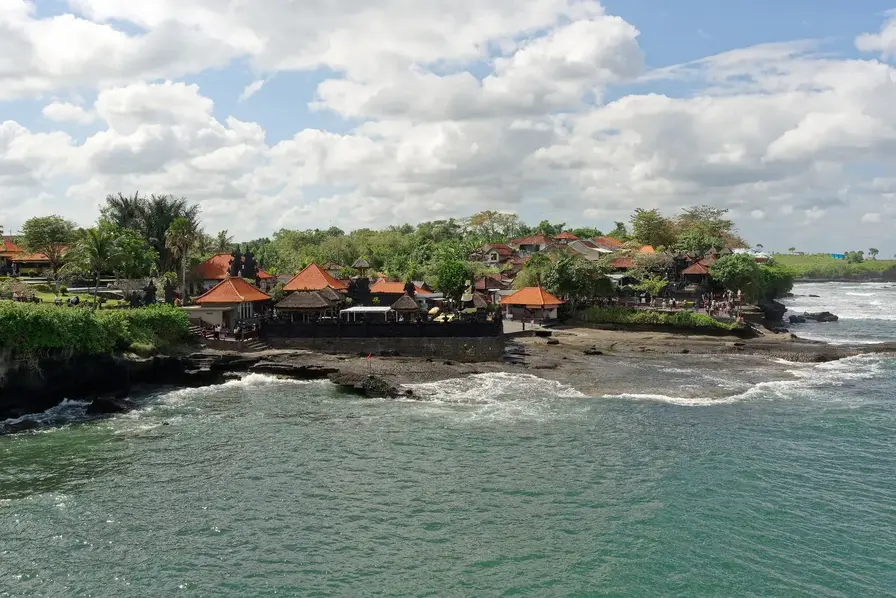
Tanah Lot, one of the temple sites where levy checks happen. Photo: Jakub Hałun, CC BY-SA 4.0, via Wikimedia Commons; resized and converted to WebP.
The airport is faster, but only if you did the paperwork
Ngurah Rai can handle about 24 million passengers a year before the current expansion push, and Bali took just over 7 million international arrivals in 2025 (Bali Sun). The transport ministry wants capacity for 32 million, and 42 million is under discussion. None of that is built yet.
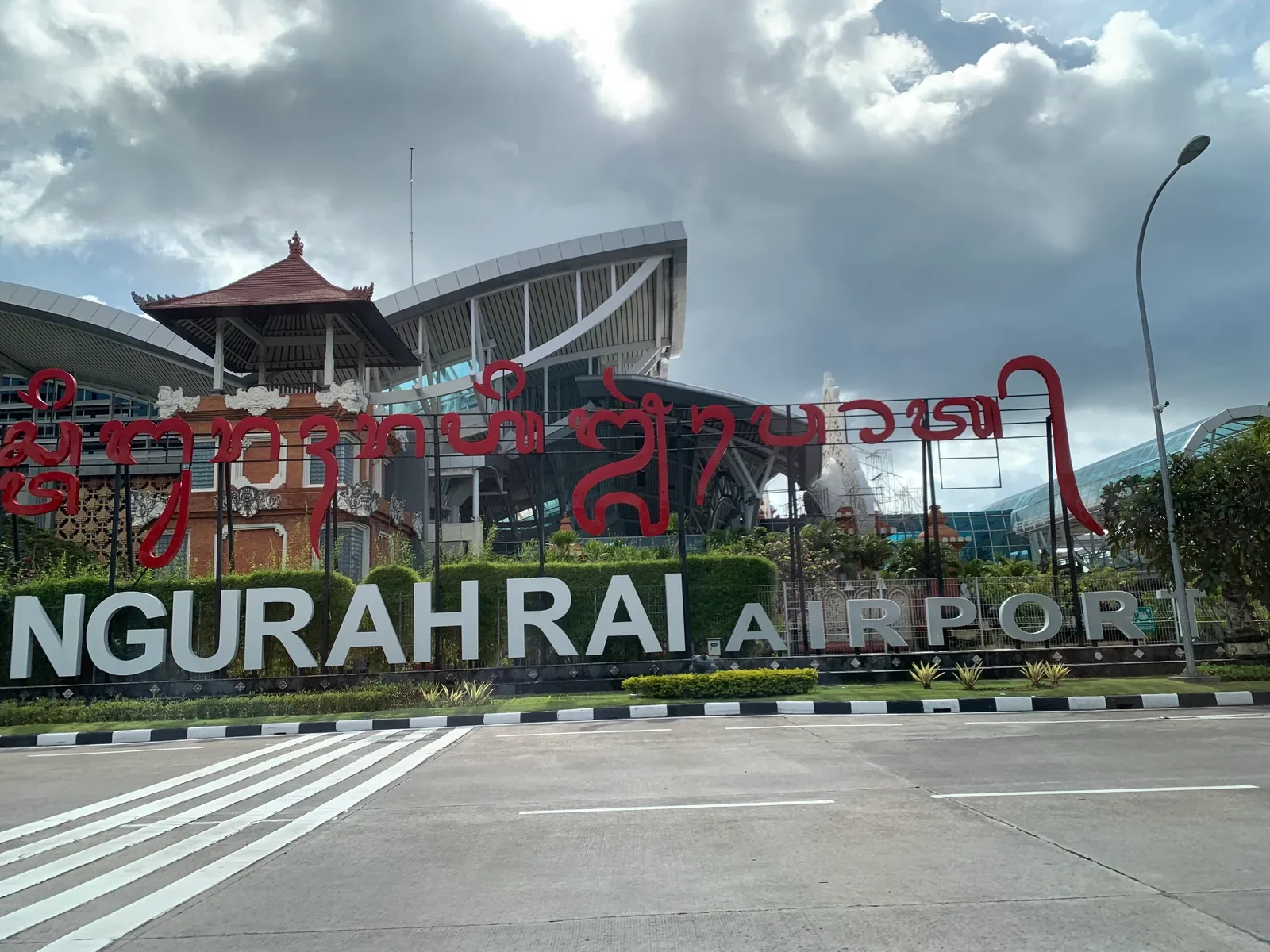
The change you will feel is process. Immigration has been re-flowing the arrivals hall so passengers go straight to the immigration line, removing the cluster of desks and agencies that used to sit in between. The autogates clear in under 30 seconds, but they only work with an e-Visa. If you buy a visa on arrival at the airport counter, you cannot use them, and you join the manual queue with everyone else.
That single detail is worth more than any terminal upgrade. Apply for the e-VOA at evisa.imigrasi.go.id before you fly, and you walk past the longest line in the building.
The second airport in the north is not a 2027 story. Construction is targeted to start in 2027 under a $3 billion agreement, which means the first flights are years away (Bali Sun). Do not plan a trip around it.
The light rail will not carry you in 2027
This is the item most likely to appear in a "Bali is getting a metro" article, so it is worth being precise.
The Rp234 trillion metro project is dead. It broke ground in September 2024 and stalled a year later for lack of investors. What replaced it is a light rail line: 12 km from the airport to Legian, then on to Canggu, budgeted at about Rp2 trillion, with roughly two years of construction once it starts (International Railway Journal).
Land acquisition has budget allocated only for 2027 and 2028, and the feasibility study has not yet been carried out (International Railway Journal). Construction is what is scheduled, not passenger service. Anyone telling you the airport train opens next year is guessing.
The road picture matters more, and it is worse. The Sterling Shortcut near Uluwatu closed without notice in February 2026, and the detour pushed Uluwatu to Jimbaran past an hour (Bali Sun). The Canggu shortcut has been motorbike-only for years. The Gilimanuk–Mengwi toll road, which would help west-bound trips to Menjangan and West Bali National Park, has slipped repeatedly and its current status is unclear.
Practical translation: if your plan involves Uluwatu and Canggu on the same day, add an hour. If it involves the airport and Ubud in the evening, add 45 minutes. This is why a driver who knows the back routes is worth more than a newer car.
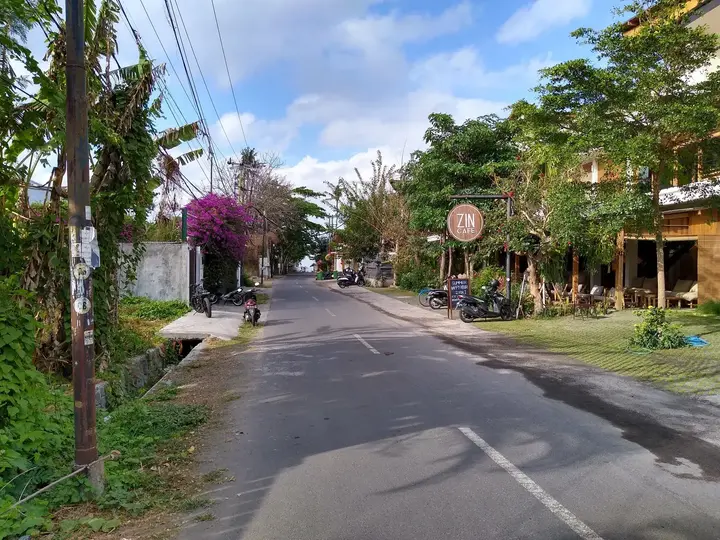
A lane in Canggu. The shortcut is motorbike-only, and the main road was not built for the traffic it carries. Photo: Mx. Granger, CC0, via Wikimedia Commons; resized and converted to WebP.
Overtourism rules: what is enforced and what is just announced
Bali has produced a lot of policy in the last two years. The gap between what is announced and what is enforced is where travelers get confused.
Enforced. Mount Agung requires a registered local guide, and the rule is policed. Climbers have been deported for going up without one, and the mountain closes in extreme weather (Bali Sun). Nusa Penida charges its own entrance fee of IDR 25,000 for adults and IDR 15,000 for children, collected at harbours and attractions, separate from the provincial levy. The governor's circular SE 07/2025 sets nine obligations and six prohibitions for tourists, including a ban on single-use plastics and a dress code at sacred sites, and Satpol PP enforces it with a WhatsApp hotline (Bali Sun).
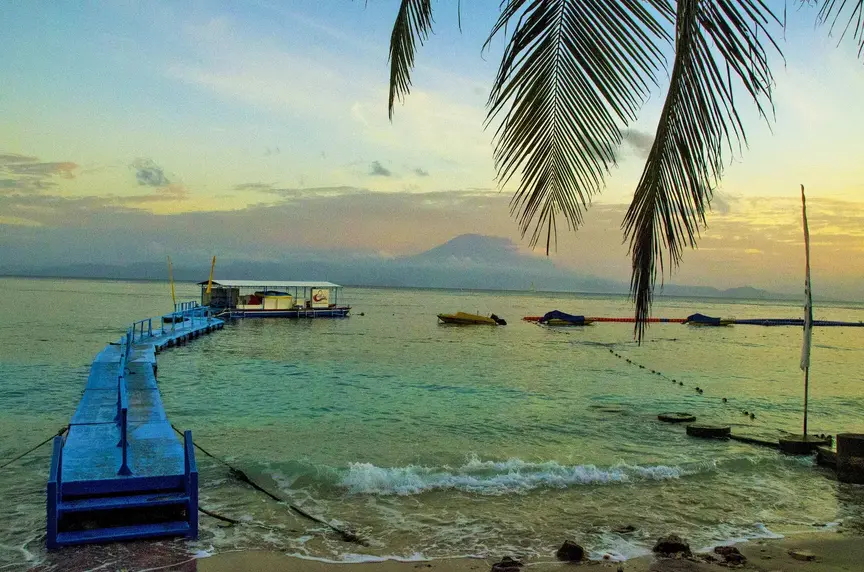
Mount Agung from Nusa Penida. Climbers need a registered guide, and that rule is enforced. Photo: Arthamade, CC BY-SA 4.0, via Wikimedia Commons; resized and converted to WebP.
Announced, not enforced. A pledge by six regencies to stop granting new hotel and restaurant permits takes effect in 2026: Tabanan, Jembrana, Buleleng, Bangli, Karangasem and Klungkung. It deliberately excludes Badung and Gianyar, which is where Canggu, Seminyak, Uluwatu and Ubud sit, and where development pressure is highest (Bali Sun). No regulation has been published, so treat it as a commitment rather than a rule you can plan around. The "waste-free by 2027" target is a deadline, not a ban, and there is no rule that changes what a visitor does (Bali Sun).
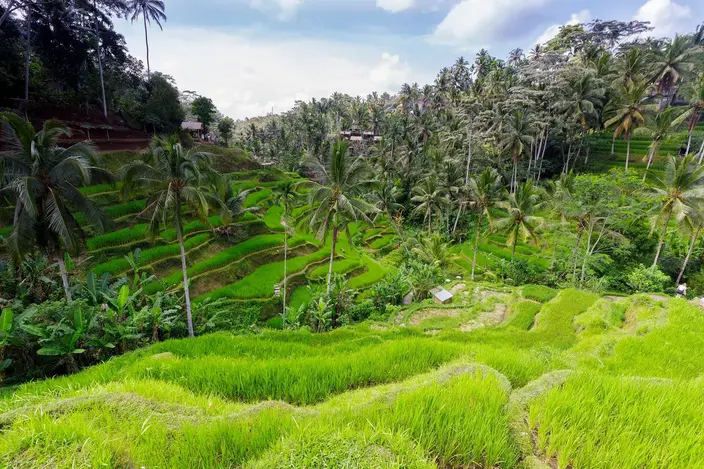
Tegalalang. Development pressure sits in Badung and Gianyar, the two regencies the permit freeze leaves out. Photo: Thomas Fuhrmann, CC BY-SA 4.0, via Wikimedia Commons; resized and converted to WebP.
Penida is the other fee that is collected, at the harbour rather than at a temple gate.
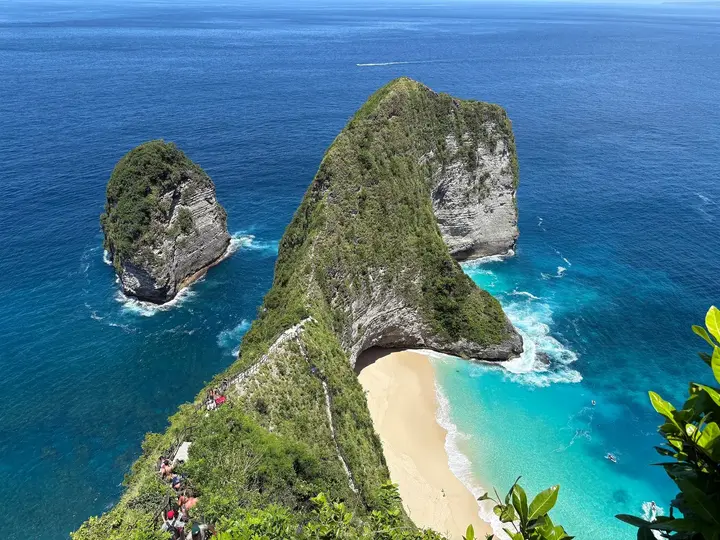
Kelingking Beach on Nusa Penida. The island charges its own entrance fee on top of the provincial levy. Photo: Chainwit., CC BY 4.0, via Wikimedia Commons; resized and converted to WebP.
So the 2027 rules that affect you are the ones that already existed: a guide on Agung, a fee on Penida, covered shoulders at temples, no single-use plastic at events, and no climbing on shrines.
New openings worth knowing about (there are not many)
Bali's hotel pipeline is enormous, but most of it is more of the same. The one confirmed 2027 opening with a real point of difference is Radisson Collection's Atiara Ubud, a 52-room property with six wellness suites, the brand's first in Indonesia (Bali Sun). If you were already planning a wellness-focused Ubud stay, it is worth a look. It is not a reason to build a trip around Ubud.

A temple gate in Ubud. New hotel supply in Gianyar is not covered by the six-regency freeze. Photo: Philip Nalangan, CC BY 4.0, via Wikimedia Commons; resized and converted to WebP.
Beyond that, 2027 is a year of construction rather than completion.
What has not changed, and matters more than any of this
The things that actually ruin trips have not moved at all.
An International Driving Permit is still required to ride a scooter legally, and a home license alone is not enough. The UK Foreign Office continues to flag a rise in fatal moped accidents in Bali, and insurers do void claims for unlicensed riders. If you would rather not deal with it, a private car charter costs less per day than most people assume and removes the entire category of problem.
Temple dress is the same as it has been for years: shoulders and knees covered, sarong and sash at any sacred site, no climbing on structures, no posing disrespectfully near offerings. Most temples lend or rent the sarong at the gate, including Uluwatu.
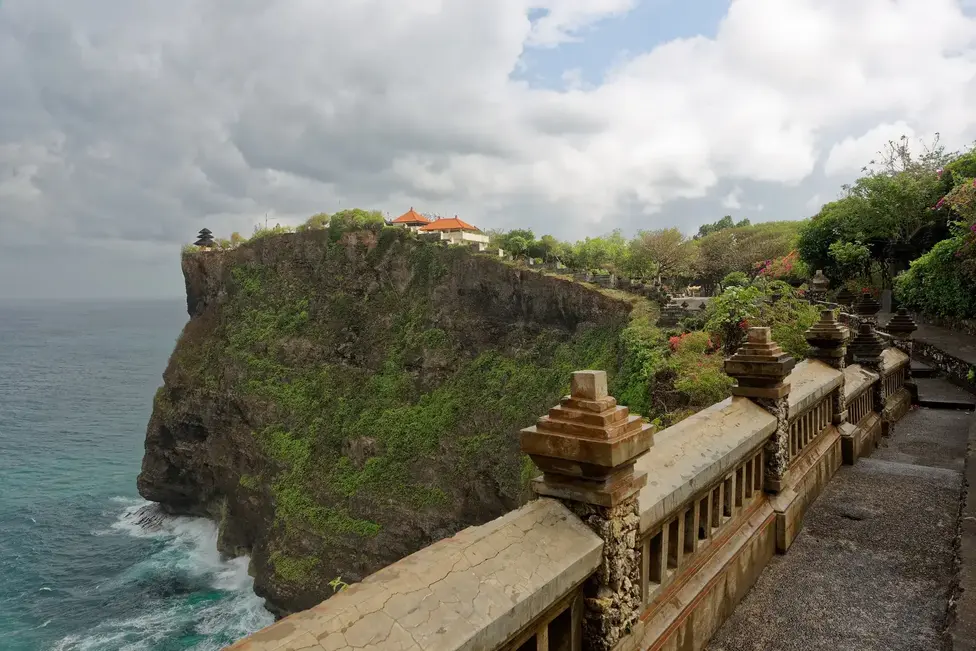
Uluwatu Temple. Sarongs are handed out at the gate, and the dress code has not changed. Photo: Jakub Hałun, CC BY-SA 4.0, via Wikimedia Commons; resized and converted to WebP.
Cash still matters. QRIS is now accepted almost everywhere locals shop, and cards work at hotels and modern restaurants, but warungs, markets, parking attendants and temple donations run on rupiah.
And the wet season still runs from November to March, with January and February the wettest stretch. If you are planning a 2027 trip around outdoor activities, that is a bigger constraint than any policy on this page.
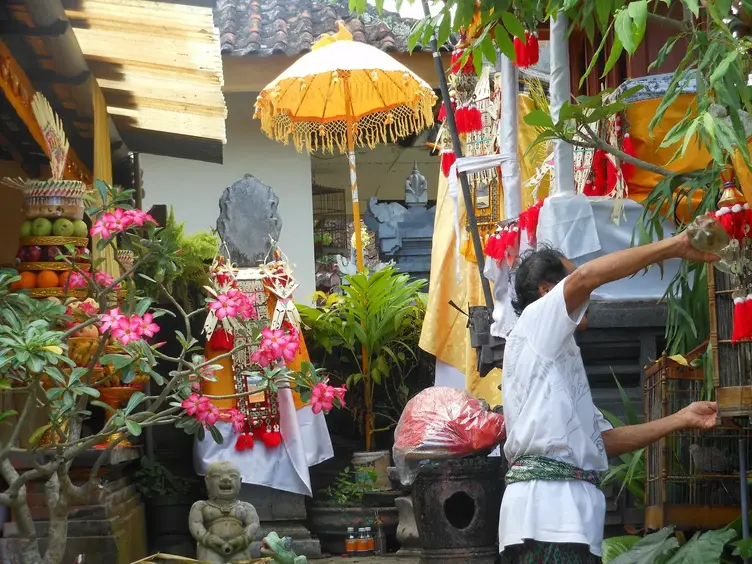
A family temple ceremony. Ceremonies still close roads and fill the calendar, whatever the new rules say. Photo: Adimelali Bali, CC BY-SA 3.0, via Wikimedia Commons; resized and converted to WebP.
The 2027 change tracker
Change | Status | Who it affects | What you do differently | Verified |
|---|---|---|---|---|
Tourist levy IDR 150,000 | In force since Feb 2024, checks expanded 2025 | All foreign visitors | Pay on Love Bali before flying, keep the QR | Nov 2026 |
Autogates at DPS | In force | Anyone who applies online | Get the e-VOA before you fly, skip the VOA counter | Nov 2026 |
Nusa Penida entrance fee | In force | Day trippers and overnight guests | Carry IDR 25,000 in cash per adult | Nov 2026 |
Mount Agung guide requirement | Enforced, with deportations | Anyone climbing Agung | Book a registered guide, check weather closures | Nov 2026 |
Sterling Shortcut closure | Closed Feb 2026 | Anyone staying in Uluwatu | Add an hour for Jimbaran and airport runs | Nov 2026 |
Hotel permit freeze | Agreed by six regencies, effective 2026; no published regulation | New development, not visitors | Nothing, but expect less new supply outside the south | Nov 2026 |
Bali LRT | Announced, construction not started | Future airport transfers | Do not plan around it in 2027 | Nov 2026 |
North Bali airport | Announced, construction targeted 2027 | Future arrivals | Ignore for now | Nov 2026 |
Radisson Atiara Ubud | Confirmed for 2027 | Ubud wellness travelers | Worth a look, not a re-route | Nov 2026 |
The short version: pay the levy, apply for the visa online, assume every drive takes longer than the map says, and do not rebuild your itinerary around infrastructure that is still a construction site. If you want the driving handled by someone who knows which shortcuts are open, start with a private car charter, or browse the curated packages that already build the transfers in.