Bali for digital nomads: long-stay bases, visas and what a month costs (2027)
October 1, 20269 min read8 views
bali-digital-nomadbali-long-stayremote-work-balibali-visa-guidee33g-visabali-coworkingcanggu-guideubud-long-staycost-of-living-balibali-2027
Bali for digital nomads: long-stay bases, visas and what a month costs (2027)
Bali is a good place to work from for one to three months. It is a bad place to base yourself indefinitely, unless you have sorted out a visa that allows it, a neighborhood that suits you, and an internet connection that survives a video call.
Most guides skip straight to the coworking list. That is the least important part. Visa status decides how long you can stay, the neighborhood decides whether you need a scooter to exist, and the uplink decides whether you can keep the job that pays for all of it.
Here is the order that actually matters.
Visa status: what you can legally do, and for how long
Indonesia has three realistic routes for someone working remotely, and they are not interchangeable.
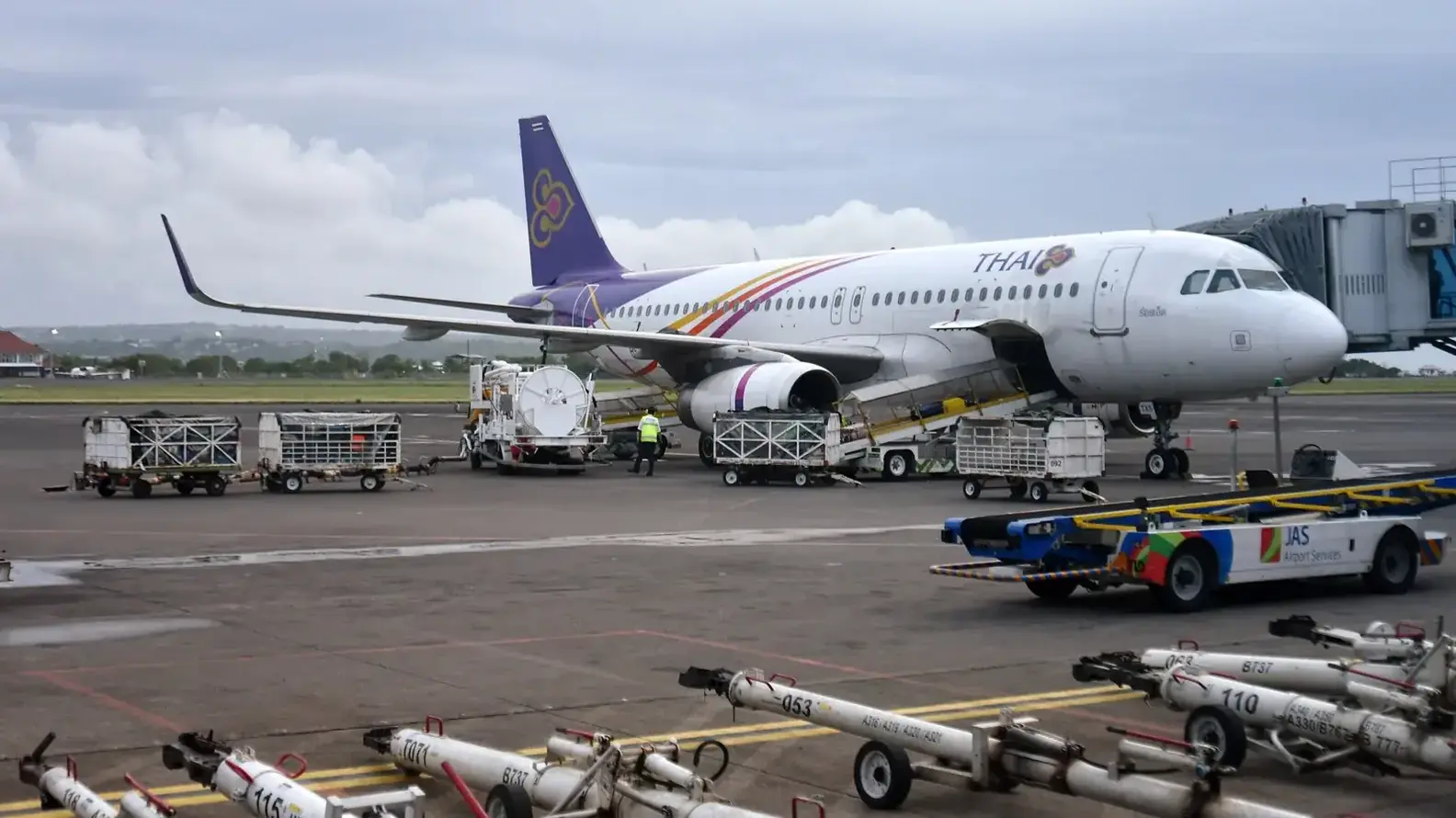
Ngurah Rai. The first decision of a long stay is which visa queue you join. Photo: Bahnfrend, CC BY-SA 4.0, via Wikimedia Commons; resized and converted to WebP.
The Remote Worker KITAS (index E33G). This is the proper long-stay permit, launched in April 2024 and applied for through evisa.imigrasi.go.id. It requires proof of employment or contracts with a foreign employer, a minimum annual income of USD 60,000 (or USD 5,000 a month), a USD 2,000 bank balance and 18 months of passport validity. It runs for one year with multiple entry, and the government fee is IDR 7,000,000 under PP 45/2024 as published; confirm the current rate before you budget. Agents charge IDR 13,000,000-17,000,000 all-in.
The restriction that catches people: it explicitly prohibits income from Indonesian companies or Indonesian clients. Remote work for a foreign employer is fine. Freelancing for a Bali-based business on this visa is not.
Renewal is unclear. One legal source says it can be renewed for another year, another says extensions are capped, a third says you must exit and reapply. If a second year matters to you, ask an agent to confirm the current rule in writing before you commit.
The e-VOA, extended once. Thirty days on arrival, one 30-day extension at IDR 500,000, 60 days total. This is the route most short-stay remote workers use, and in practice nobody stops you for six weeks. But neither the e-VOA nor the 60-day visit visa carries work permission. If you need to be unambiguously compliant, the E33G is the only one of the three that grants remote-work rights.
The single-entry visit visa (index C1, the successor to the B211A). Sixty days on entry, extendable in 60-day blocks to a maximum of 180 days. Published fees run IDR 2,000,000 per extension, or IDR 6,000,000 for the full 180; confirm the current schedule before you budget. There is no income test. This is the practical instrument for a three-month stay.
One number sits underneath all three: 183 days in any 12-month period can make you an Indonesian tax resident. It is one of several tests, and a tax treaty can override it. Past that line, worldwide income comes into scope on a progressive scale up to 35 percent. A 90-day stay is a holiday with a laptop. A six-month stay lands close enough to the line to be a tax question, and you should ask an accountant, not a blog.
Six bases, judged for a month rather than a week
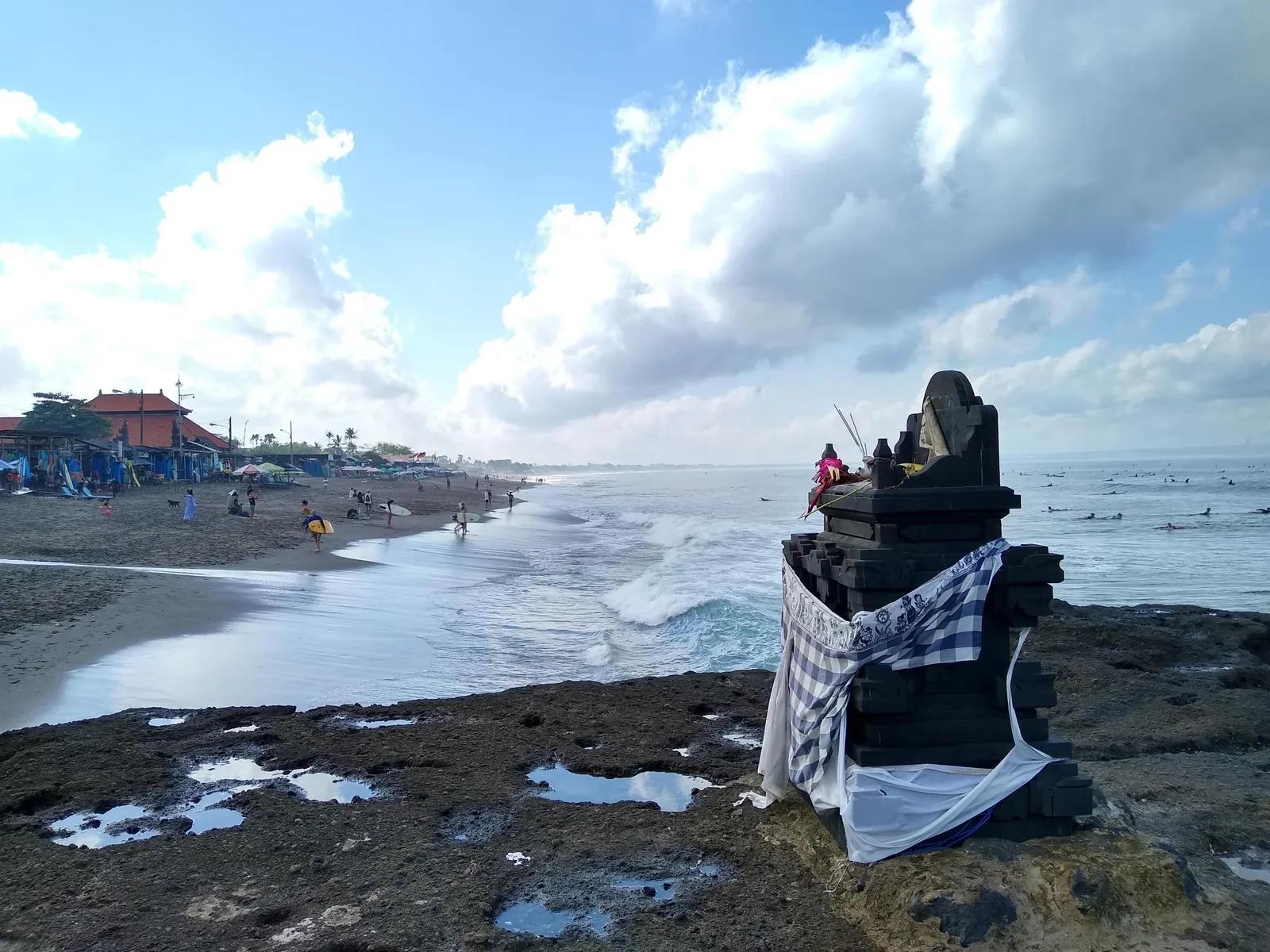
Canggu and Pererenan. The deepest coworking supply on the island, the biggest cafe scene, the worst traffic, and some of the highest rents. Batu Bolong is the social center; Pererenan, ten minutes north, is quieter and dearer at the entry point, though Canggu's ceiling is higher. Choose Canggu if you want people and accept noise. Construction starts at 07:00 and ceremonies run late.
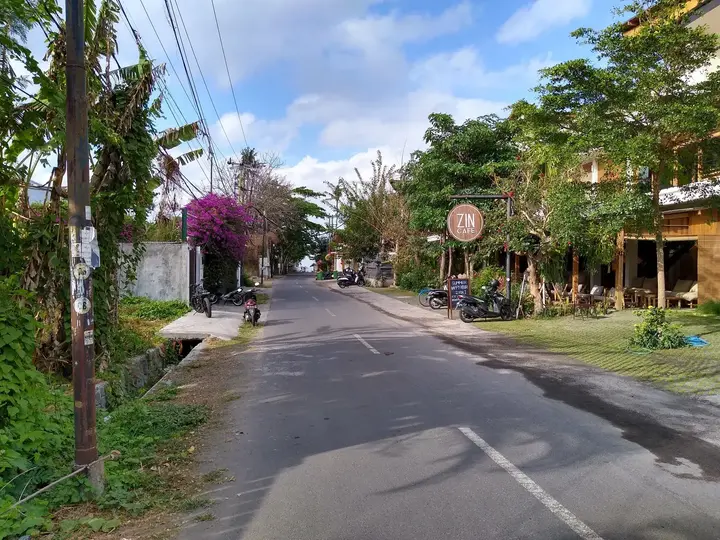
A lane in Canggu. Walkable in the morning, a scooter ride by noon. Photo: Mx. Granger, CC0, via Wikimedia Commons; resized and converted to WebP.
Ubud. Cheaper rent than the coast, two Outpost locations, and a different pace. The catch is that fiber thins quickly outside the center, and the noise profile is roosters, dogs and gamelan rather than scooters. It suits people who work in long blocks and do not need a social scene every night.

Rice terraces outside Ubud. Fiber thins out fast beyond the center. Photo: Yurianto76, CC BY-SA 4.0, via Wikimedia Commons; resized and converted to WebP.
Sanur. The practical option. Walkable, flat, low noise, a paved beachfront promenade, and Livit Hub as a coworking anchor. Rent sits below Canggu, though not below Ubud. It is also the ferry port for Penida and the Gilis, which makes weekend trips easy. Less fashionable, more livable.
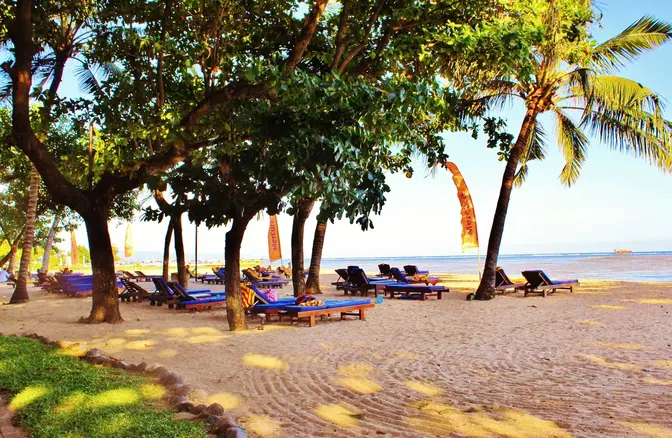
The Sanur promenade. Flat, shaded and walkable, which is rare here. Photo: Michelle Maria, CC BY 3.0, via Wikimedia Commons; resized and converted to WebP.
Bingin and Uluwatu. Cliff views, surf, and a rent premium. Fixed-line internet is the weakest of the six, so Starlink is the realistic fix. You need a scooter or a driver for everything. Great for a month if you surf, tiring if you do not.
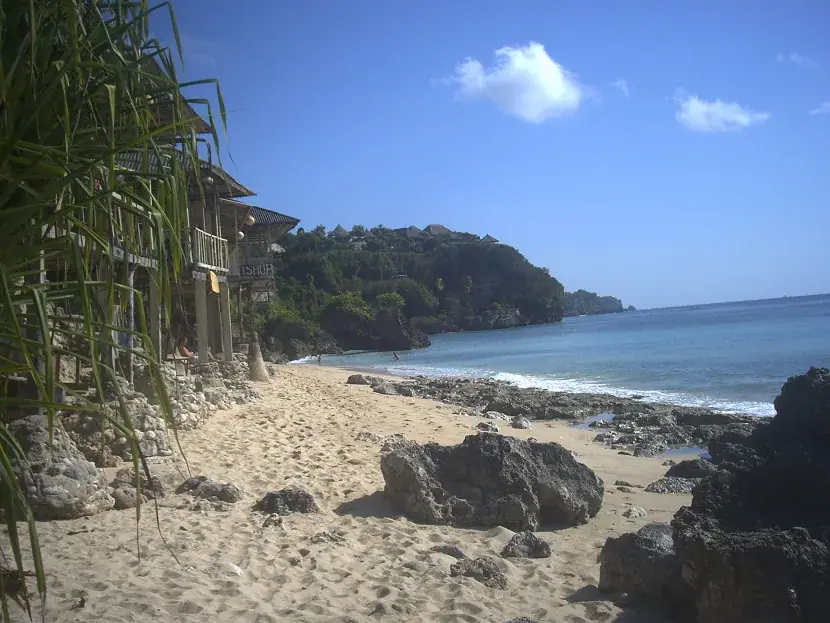
Bingin. Cliff stairs, surf, and the weakest fixed-line internet of the six bases. Photo: Gsarwa, CC BY-SA 3.0, via Wikimedia Commons; resized and converted to WebP.
Amed. Northeast coast, black sand, cheap rent, excellent diving, no coworking scene and no ride-hailing coverage. A scooter is mandatory and 4G is your uplink. This is the "I actually want to disappear and work" option.

Amed. No coworking, no ride-hailing, excellent diving. Photo: Wawansatriawan bali, CC BY-SA 4.0, via Wikimedia Commons; resized and converted to WebP.
Sidemen. East Bali, valley views, the quietest of the six, and the least infrastructure. Same caveats as Amed, with fewer restaurants. Beautiful for a week, isolating for three months.

Harvest in Sidemen. The quietest base, and the least infrastructure. Photo: rahmat nugroho, CC BY-SA 4.0, via Wikimedia Commons; resized and converted to WebP.
The rule of thumb: south of the airport ring, a scooter is optional. Everywhere else, it is required.
What a month actually costs
Monthly rents for a one-bedroom pool villa, from current listings:
Base | Monthly range (IDR) | Approx. USD |
|---|---|---|
Ubud | 18,000,000-35,100,000 | $990-1,930 |
Canggu | 19,800,000-50,400,000 | $1,090-2,770 |
Sanur | 19,800,000-39,600,000 | $1,090-2,180 |
Pererenan | 25,200,000-45,000,000 | $1,380-2,470 |
Uluwatu / Bingin | 25,200,000-64,800,000 | $1,380-3,560 |
Those are villa numbers. A plain one-bedroom apartment in Denpasar averages IDR 6,390,000 in the center and IDR 2,780,000 outside it, which tells you how much of the Bali premium is the pool, the view and the postcode.
On top of rent:
Coworking: IDR 2,250,000-3,850,000 a month for a standard desk; Livit's Ultimate tier reaches IDR 5,780,000.
Scooter: IDR 80,000-150,000 a day, and monthly rates are negotiable. A 30-day rental should cost well under the daily rate times 30.
Utilities: around IDR 900,000 a month for an 85 square meter apartment, more with pool pumps and two air conditioners running.
Broadband: around IDR 302,000 a month where fiber exists. Mobile is around IDR 72,500.
Food: warung meals IDR 15,000-50,000, cafe meals IDR 60,000-150,000.
Deposits are usually one to three months plus the first month, and plenty of landlords want the whole lease paid upfront. Ask about cleaning fees and pool maintenance before you sign, because they are rarely in the headline rent.
A realistic all-in month in Canggu, in a one-bedroom villa in the lower half of that rent range (IDR 20,000,000-30,000,000), with coworking and a scooter, lands around IDR 30,000,000-45,000,000 ($1,650-2,470). Amed and Sidemen sit below the Ubud floor, though neither has a villa market deep enough to quote a reliable band.
Internet, power and the working day
Residential internet in Bali is improving and still unreliable. Coverage is street by street, so the question to ask a landlord is not "is there wifi" but "which provider, and how fast at 20:00".
The failure mode that matters is not a slow line. It is the router dying when the grid flickers. A UPS and a Telkomsel hotspot cover most of it for a small one-off cost.
Starlink is available and priced at IDR 750,000 a month, with hardware around IDR 5,400,000-7,800,000, so IDR 6,150,000-8,550,000 to start, first month plus hardware. It is worth it in Bingin, Amed or Sidemen, where fiber is absent. It is overkill in Canggu, where a coworking desk already has redundant lines and a generator.
Before any call that matters: test the actual desk at the actual hour, and hold the call at a coworking space if it is important.
Coworking: most published lists are stale
Bali's coworking scene has consolidated hard, and half the lists still online are out of date.
Dojo Bali, the space that defined Canggu coworking, closed in December 2022. Its own site still says so. Outpost's Canggu floor is gone, leaving Ubud (Nyuh Kuning and Penestanan). Genesis has discontinued coworking, Karya is paused, and Kinship Studio is listed as closed.
What is open and priced, checked in November 2026:
Space | Location | Monthly | Day pass |
|---|---|---|---|
BWork | Canggu, Uluwatu | IDR 3,850,000 | IDR 299,000 |
Livit Hub | Sanur | IDR 2,250,000 (Basic) | - |
Outpost | Ubud | IDR 2,678,000 | IDR 258,000 |
Tribal | Pererenan | Free with a cafe order | - |
Livit's Pro tier is IDR 4,875,000 and Ultimate is IDR 5,780,000 including VAT. The cheapest desk in the table is Outpost Ubud at IDR 2,678,000; Canggu runs higher, and day passes are IDR 258,000-299,000.
The cafe-as-office reality is still the default. Most people buy two coffees and work from a table until lunch. It works, it is cheap, and it stops working the moment you need a quiet room for a client call.
Living there: the friction points
The banjar, the neighborhood council, is the unit you live inside. Ceremonies close roads, gamelan practice runs late, and renters in some areas are asked for small contributions, commonly IDR 100,000-300,000, at temple anniversaries. This is normal, not a scam. Ask the owner what the expectation is before you move in.
Waste burning is the biggest quality-of-life issue and it is now enforced. Illegal burning carries up to three months in jail or a IDR 50,000,000 fine, and 28 residents were charged in a 2026 enforcement round that explicitly included foreigners. If a neighbor is burning plastic next to your villa, that is a reportable offence, not just an annoyance.
Riding legally needs a motorcycle license, a category A International Driving Permit and the bike's STNK. Fines reach IDR 1,000,000, and insurers void claims for unlicensed riders. The police do stop foreigners, and "everyone does it" is not a defense that works at a checkpoint.
The behaviors that make long-stayers unpopular are consistent: arguing with a procession instead of stopping, refusing the banjar contribution, burning rubbish, treating a residential lane as a racetrack, and complaining that Bali is not like home. The ones who get invited back learn to stop the scooter, wait, and say terima kasih.
The version that works
A three-month stay works if you pick a visa you qualify for, choose a base for the month rather than the week, and solve the internet before you need it. It stops working when you stretch a visit visa into a permanent arrangement, pick Canggu because it is where everyone else is, and discover in week six that the thing you cannot buy here is quiet.
If you are testing the idea, start with a month in Sanur or Ubud, keep the first week in a hotel while you look at rentals, and book an airport transfer so arrival is not a negotiation. If you decide to stay longer, the curated packages cover the first week while you sort out a lease.