Bali travel essentials: your ultimate guide to island adventures and must-haves
November 4, 202612 min read6 views
bali-travel-tipsbali-travel-2027first-time-in-balibali-tourist-taxbali-packing-listbali-entry-requirementsbali-travel-guideairport-transfers-baliesim-balibalinese-etiquette
Bali travel essentials: your ultimate guide to island adventures and must-haves
Most Bali packing lists were written before the island went digital. They still tell you to complete a customs form on the plane, buy a SIM at the airport, and hand over cash for the tourist levy. None of that is how it works now.
You need four things before you board. Each one costs money, and none of them replaces another.
What to actually do in Bali
The island is big enough that a month still leaves gaps, but the distances are deceptive. A short drive across the south can take 90 minutes at 5pm. Since the Sterling Shortcut above Uluwatu closed in February 2026, the Jimbaran run takes an hour at peak (Bali Sun). Plan one area a day.
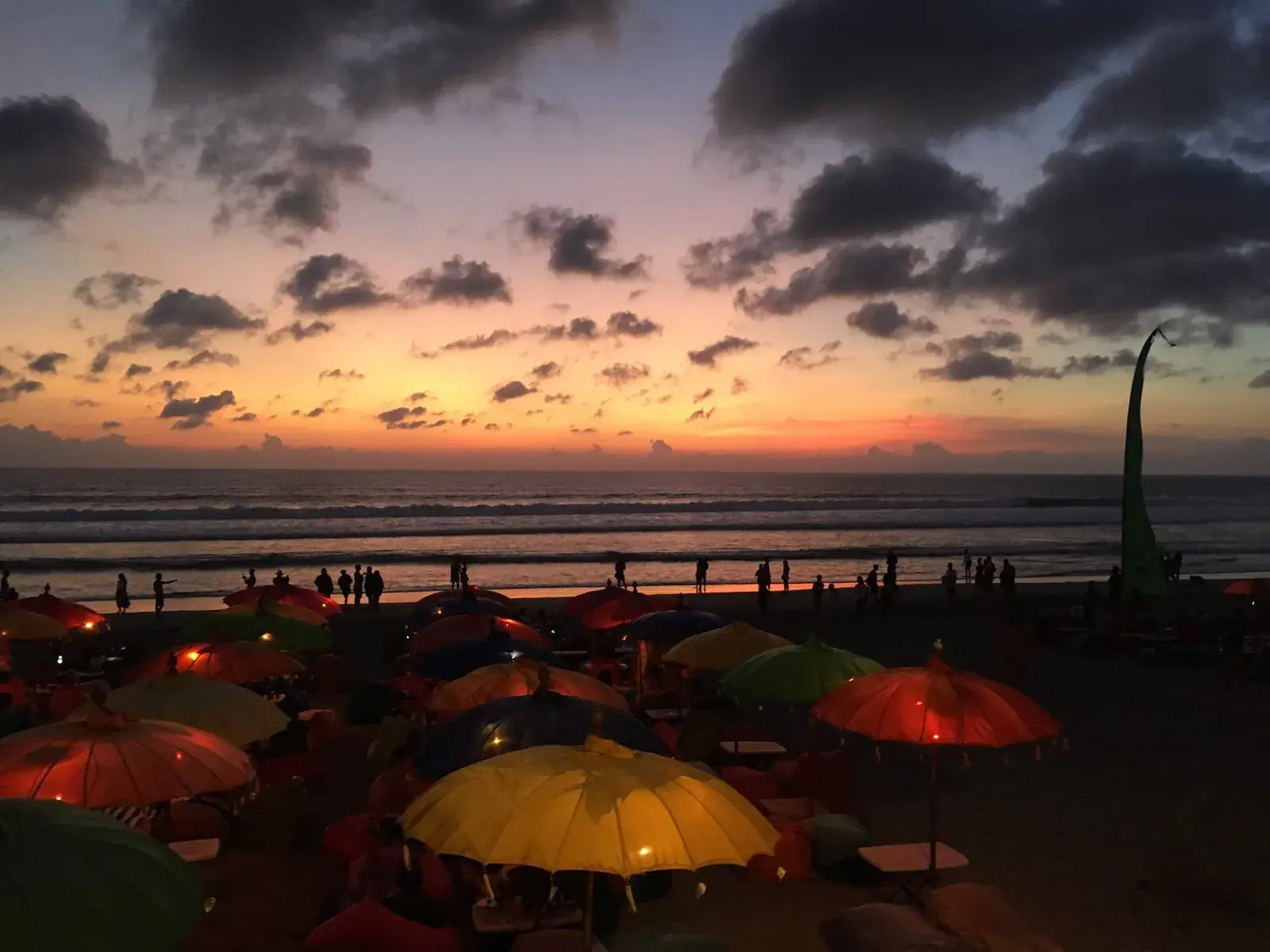
Seminyak at sunset. The south coast beaches fill up in the last hour of the day. Photo: Christophe95, CC BY-SA 4.0, via Wikimedia Commons; resized and converted to WebP.
The beaches vary a lot. Kuta is loud, social and packed with surfers. Seminyak is cocktails at sunset territory. Nusa Dua is quiet and resort heavy. Pick by mood, not by what looked good on someone else's feed.
For culture and art, Ubud is the obvious choice, and for good reason. The rice terraces are real, the art scene is lively, and the Sacred Monkey Forest is worth two hours (keep your sunglasses in a zipped bag). The sea temples along the coast are worth a morning.
For adventure, the surf is the draw if you know what you are doing. If you do not, lessons are cheap and everywhere. Waterfalls are scattered through the interior, and white water rafting on the Ayung River is a solid half day.
Balinese food is heavily spiced and good. Try babi guling (roast suckling pig) and ayam betutu (slow cooked spiced chicken) at a warung rather than a tourist restaurant. You will pay a fraction of the price and get the real thing.

The Monkey Forest is a temple and a conservation site, not a petting zoo. Keep snacks zipped away. Photo: rheins, CC BY 3.0, via Wikimedia Commons; resized and converted to WebP.
Mandatory entry requirements
You need all four, and each is checked at a different point. One payment does not cover another.
1. Passport validity and return ticket
Your passport needs at least six months of validity from your arrival date, two blank pages, and no damage. Airline staff refuse a torn cover or peeling laminate at check-in, before you reach immigration. You also need proof of an onward or return ticket out of Indonesia. Save it offline before you fly. Airport wifi is not the place to look for a booking email.
2. The "All Indonesia" digital arrival form
The paper card is gone. Since September 2025, immigration, customs, health and quarantine declarations are one free online form at allindonesia.imigrasi.go.id. Submit it within 72 hours of arrival, one per person including children and infants, and save the QR code to your phone.
Any site that charges you to complete it is not the government one. The real form ends in and costs nothing.
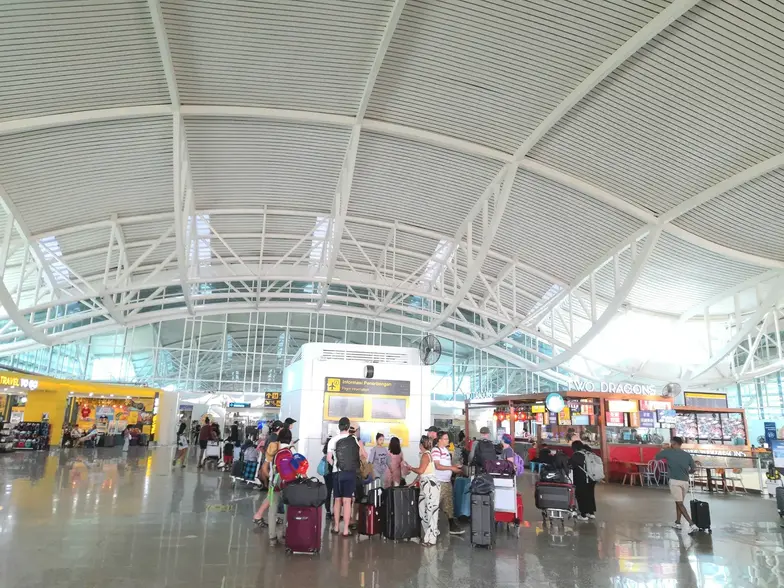
The international terminal at Ngurah Rai. With an e-VOA you walk past the visa counter and head for the autogates. Photo: Ardfeb, CC BY-SA 4.0, via Wikimedia Commons; resized and converted to WebP.
3. Visa on Arrival (VoA)
Most nationalities qualify. It costs IDR 500,000 for 30 days, with one 30-day extension for the same fee. You can pay at the airport, but apply for the e-VOA in advance at evisa.imigrasi.go.id instead.
The reason is queue time. The autogates at Ngurah Rai only read visas issued before arrival. With an e-VOA you clear in about 30 seconds. Without one, you join the manual queue with everyone who bought a visa at the counter.
4. Bali tourist levy
All international visitors pay IDR 150,000 per person, once per trip, to fund environmental and cultural preservation. It has cost the same since February 2024, and nothing announced for 2027 changes it (Love Bali).
Pay before you fly on the Love Bali site. Payment is cashless, and the QR voucher arrives by email, usually within ten minutes. Keep it on your phone. Officers check vouchers at Uluwatu, Tanah Lot and in resort spot checks.
Enforcement is the part that changed. Compliance sat around 35 percent in 2025 and rose to roughly 43 percent in the first eight months of 2026 (Simply Indonesia). The province widened collection in response. Hotels, agents and attractions can now take payment, and since late August 2026 airlines announce the levy on inbound flights.
There is still no published fine for skipping it. In practice, staff turn you away at the gate. Children are not on the exemption list. KITAS and KITAP holders, diplomats, crew and students are.
What the paperwork costs
Item | Cost | Where | Notes |
|---|---|---|---|
Tourist levy | IDR 150,000 | Love Bali, before you fly | Per person, once per trip. No child exemption. |
e-VOA | IDR 500,000 | evisa.imigrasi.go.id | 30 days. One 30-day extension at the same price. |
Arrival card | Free | allindonesia.imigrasi.go.id | One per person, within 72 hours of arrival. |
Overstay | IDR 1,000,000 per day | Airport immigration | Charged daily. No grace period. |
Fees verified 19 November 2026 at IDR 18,200 to the dollar. Confirm on the official portals before you pay.
Getting around
Bali has no train or metro. Everything moves on roads that were not built for the volume, which makes transport the one thing worth booking before you land.
Airport transfers
Ride-hailing is legal and cheaper, but Grab and Gojek pick up from a designated area outside the terminal, a five to ten minute walk with your bags. The taxi counter inside arrivals sells fixed-price zones, and you pay before you ride.
Neither is a disaster. Both are worse than a driver who waits with your name on a sign, especially if you land at 11pm and your hotel is in Ubud. After a long flight, you do not want to haggle in an unfamiliar arrivals hall.
Private car charter
A full day with a car and driver typically runs IDR 500,000 to 700,000, fuel included. Tickets and lunch cost extra.
You set the route. Want an extra hour at a temple? Fine. Spot a roadside warung that looks good? Pull over.
That flexibility matters more than it used to. Shortcuts close without much notice, and a driver who works the same roads every week knows which ones are still open. Book through the private car charter page and you get someone who also knows when to leave.
Scooters, ride-hailing, and taxis
A scooter is still the cheapest way to reach the beaches and warungs that are not on a map. The rule is years old, and enforcement is new.
You need an International Driving Permit with the motorcycle category, plus your home license. A car license is not enough. Many cover a 50cc moped, and almost every rental on the island is 125cc or larger (Bali Sun). Rental outlets have been told to check, and some now ask for a short test ride before they hand over the key. Police run spot checks on the main roads.
The bigger risk is financial. Insurers void claims for unlicensed riders, so a crash can mean paying for surgery yourself. If you do not ride confidently in traffic, do not learn here.
For short trips, Grab and Gojek work, and the app fixes the price. Bluebird is the metered taxi company worth flagging down. Some villages restrict ride-hailing pickups near temples and markets, so expect to walk a few hundred meters to the car.
Tip: Download your area on Google Maps for offline use before you head out. Signal is patchy in the hills, and Bali's roads do not always follow obvious logic.
What to pack: clothing and accessories
Pack light. It is hot and humid year round, and laundry is cheap.
Swimwear plus a sturdy pair of flip-flops or reef sandals covers the beach, the pool and most of town. For temple stairs, waterfall treks and rice terrace paths, bring one pair of grippy shoes. Leave the sneakers at home unless you plan to climb a volcano.
Bring a sarong. You need one at any temple, most rent or lend one at the gate, and it doubles as a towel, a cover-up and a picnic blanket.
Sun and rain protection: bring a hat, sunglasses, reef-safe sunscreen and a compact rain poncho. Tropical showers come fast and leave fast.
One thing changed in 2026. Bali bans single-use plastic, including water bottles under one liter, and the ban is now fully in force. Bring a refillable bottle and a foldable bag. Most cafes and hotels refill the bottle for free.
Travel gear and staying connected
Bring a universal travel adapter (Bali uses the two pin round plug, Type C/F) and a portable power bank. Your phone will die faster than you expect when you use GPS all day.
Data is the part people get wrong. Since 1 July 2026, every new Indonesian SIM, including locally issued eSIMs, needs a face scan at registration. Starter packs stay inactive until the check clears. Bring your passport and your visa, allow 15 to 30 minutes at an official store, and never buy a pre-registered card from a street seller (Simply Indonesia).
There is also an IMEI rule, and it is less frightening than it sounds. Foreign phones get temporary access to local networks for up to 90 days when the operator registers the SIM to your passport. That covers a normal holiday. Stay longer, or keep a local number, and you must register the handset with customs. The first USD 500 of value is duty-free. Above that you pay 10 percent duty plus 11 percent VAT.
The simplest route is a travel eSIM bought before you fly. It runs as roaming, so it never touches the IMEI registry or the biometric queue. You land with data and can book a car while the bags are still coming out.
Telkomsel has the widest coverage, including Nusa Penida and the north coast. XL, now merged with Smartfren as XLSmart, is often faster in Canggu, Seminyak and Ubud, and weaker in the mountains.
Connectivity options through BaliRoam
3G/4G prepaid SIM card (hotel delivery).
Your physical SIM card gets delivered to your hotel or villa front desk on your selected arrival date (between 07:00 and 19:00). Coverage areas include Nusa Dua, Jimbaran, Uluwatu, Kuta, Legian, Seminyak, Kerobokan, Canggu, Denpasar, Sanur, Gianyar, and Ubud. A BaliRoam team member can help with registration and activation if needed.
Prepaid SIM by Javamifi (hotel drop off).
Delivered to your accommodation within Bali city limits. Enter your hotel name and primary guest reservation name at checkout so the front desk can accept the package. Indonesian law requires IMEI registration for foreign phones used on local networks beyond 90 days. The operator registers the shorter tourist access against your passport. You will need your phone model and IMEI number (dial to find it). Your passport details are collected only for the mandatory registration, submitted through encrypted transmission, and retained only as long as Indonesian regulations require.
Instant 4G eSIM for Southeast Asia.
No physical card. Match your pickup date with your departure date and you will receive a digital voucher instantly. To install: go to Settings > Cellular, tap Add Cellular Plan, and scan the QR code before boarding or after landing. To remove it when your trip ends, go back to Cellular settings, select the plan, and tap Remove Cellular Plan. Validity runs in calendar days.
Health, safety, and money
Staying well, and what to do when you are not
Pack a small first aid kit: band aids, antiseptic, pain relievers, rehydration salts, diarrhea tablets. Stomach trouble is common in the first week. Drink bottled or filtered water, skip ice from a roadside cart, and eat where the tables are full. A warung with a line of locals at lunch is fresher than an empty restaurant with a nice menu.
Two things are worse than an upset stomach. Dengue is the first. Gianyar, the regency around Ubud, recorded 4,478 cases in 2024. Badung, which covers Canggu, Seminyak and Uluwatu, recorded 2,405, double the previous year (Bali Sun). The mosquitoes that carry it bite in the morning and late afternoon, so repellent is a daytime habit, not a night one.
The second is methanol in cheap spirits. Drink where there is a license and a menu with prices, and skip the free-pour "special" at a bar with no menu.
If it gets serious, BIMC and Siloam have emergency departments. Bali International Hospital opened in Sanur in June 2025 with 255 beds and a full ER (Bali Sun). Call your insurer before you check in, because hospitals often ask for a payment guarantee.
If you take a fast boat to the Gili Islands or Nusa Penida, bring motion sickness pills and cross in the morning. The afternoon waves get rough.
Cash matters
High end hotels and modern restaurants take cards. QRIS, the Indonesian QR payment standard, works in almost every shop locals use. Everywhere else you need rupiah: markets, warungs, parking attendants, temple donations, drivers.
Get cash from a bank ATM early. Indonesian ATMs dispense the notes before they return your card. That sequence makes people walk away without it. Take the cash, then wait for the card.
ATM warning: count the notes before you step away, and use a machine attached to a bank rather than the freestanding ones in convenience stores.
Change money at a bank or a licensed changer that displays the Bank Indonesia QR logo. The kiosk with the best rate on the street is usually the one with the worst arithmetic.
When to go, and one rule that is still a draft
One date matters more than the rest in 2027. Nyepi, the Day of Silence, falls on 8 March. The island shuts for 24 hours. The airport closes, hotels do not check guests in or out, and nobody leaves the compound. Book the nights either side, and confirm your hotel can feed you.
The rest follows the usual pattern. June to September is peak. Christmas and New Year is the second spike. The wet season runs November to March, and January and February are the wettest. That matters more for waterfall and trekking plans than for a beach trip.

Nusa Dua in the dry season. June to September brings the clearest water and the largest crowds. Photo: Anton Ardyanto, CC BY-SA 4.0, via Wikimedia Commons; resized and converted to WebP.
The one policy to watch is the quality-tourism regulation. In January 2026 the governor said the province would screen incoming tourists on their finances, length of stay and planned activities (Antara). It is still a draft. The province has published no minimum balance, and the rule is not in force. Do not carry three months of bank statements on its account. Check again a month before you fly.
Sort the four pre-arrival items and book the first night's transfer. Leave the rest of the itinerary in pencil. You will spend the trip enjoying the island instead of troubleshooting.
BaliRoam handles the parts that are hard to improvise: airport transfers, private drivers, SIM cards and tours. The curated packages build the first two days for you, or create a free account and book only what you need.
Frequently Asked Questions
What documents do I need to enter Bali in 2026?
Your passport needs at least six months of validity. All Indonesia digital arrival form is required for all international arrivals and may be completed up to three days before arrival. If eligible, you can get a Visa on Arrival (IDR 500,000 for 30 days) or apply for the e-VOA online to bypass the visa-payment counter at the airport. The Bali tourist levy of IDR 150,000 applies to most visitors (some exemptions exist for diplomatic and certain visa holders).
Do I need a special license to rent a scooter in Bali?
Yes. You need a valid International Driving Permit (IDP) with motorcycle endorsement (Category A) in addition to your home license. Police run checkpoints around Canggu and Seminyak. Riding without an IDP also voids most travel insurance policies.
What should I pack for a trip to Bali?
Pack light. Bring swimwear, a sturdy pair of flip-flops or reef sandals, a sarong for temple visits, reef-safe sunscreen, a hat, sunglasses, and a compact rain poncho. Leave the sneakers at home unless you are planning a volcano hike.
How do I avoid Bali Belly?
Stick to bottled or filtered water. Be cautious with ice at small street stalls. Eat at busy local establishments where high turnover means fresher food. Pack a small first aid kit with oral rehydration salts and diarrhea medication (avoid if you have a fever or bloody stool).
What is the best way to get around Bali?
Bali has no train system. For flexibility, book a private car with a driver who knows the roads. For short trips, use Grab or Gojek ride-hailing apps. If you rent a scooter, carry an International Driving Permit, wear a helmet, and download offline Google Maps before heading out.