A food lover's guide to Balinese cuisine: what to order and what it costs in 2027
November 11, 20268 min read6 views
balinese-foodbali-culinary-guidebali-travel-tipsbali-warungsvegetarian-balisanur-night-marketbabi-gulingnasi-campurubud-food-guidesate-lilit
A food lover's guide to Balinese cuisine: what to order and what it costs in 2027
Bali gets more attention for its rice terraces and beach clubs than for its food, which is a mistake. The island's Hindu kitchens cook with pork, coconut, turmeric and fermented shrimp paste. You will not find those combinations across the strait. The best of it still costs about as much as a flat white in Canggu.
Prices have split. A local babi guling warung sells a full plate for IDR 12,000 to 48,000. A mid-range restaurant meal for two averages IDR 509,000, or about IDR 255,000 each. That gap depends on what you order and where you sit.
The spice paste behind most dishes
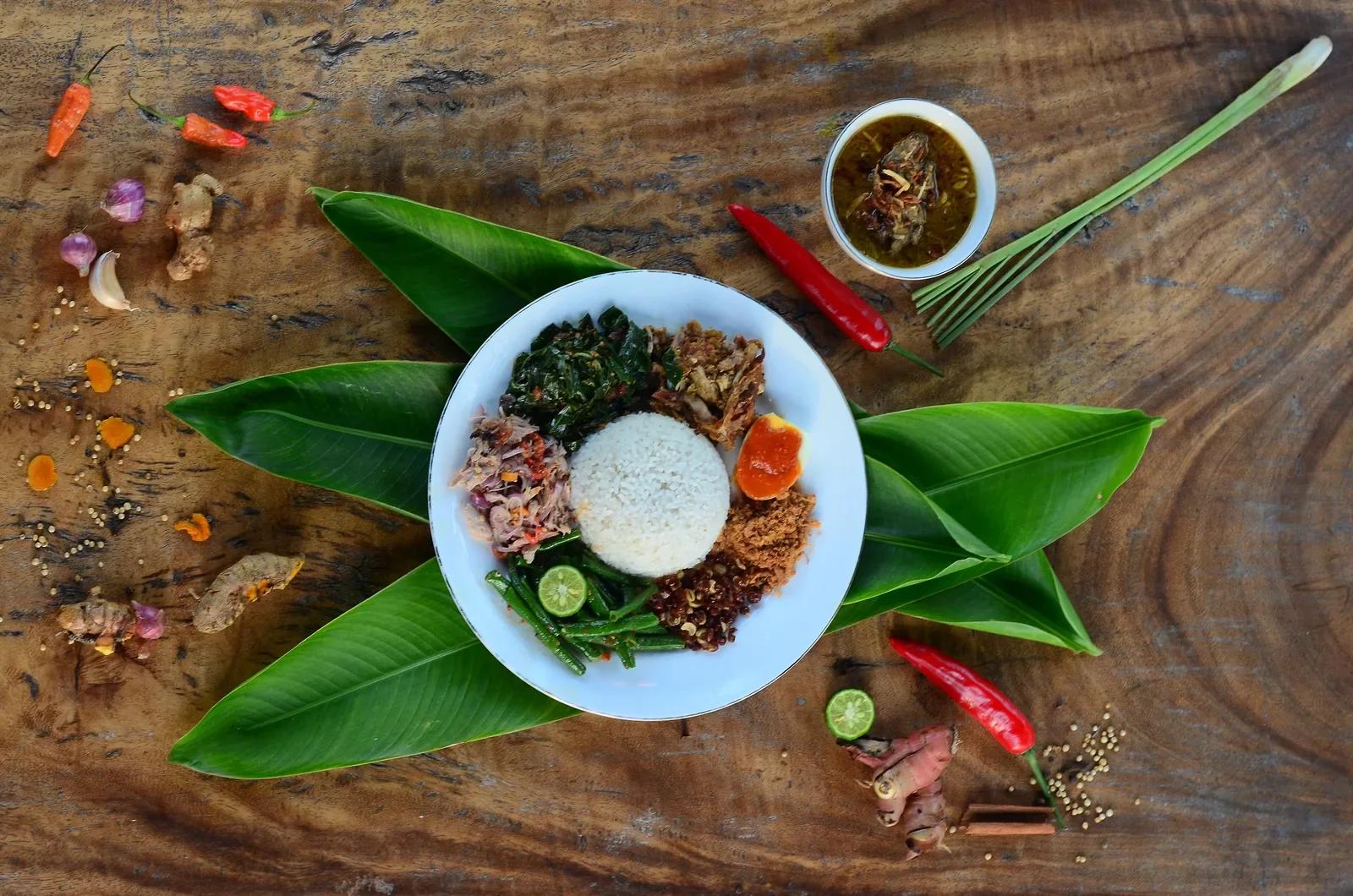
Most savory Balinese dishes start with base genep, the "complete spice paste". Cooks grind it fresh in the morning with a stone mortar: shallots, garlic, ginger, galangal, turmeric, kencur, candlenut, coriander, chili, lemongrass, lime leaves and terasi.
Every family has a version. The paste is why babi guling, lawar and nasi campur taste related even when they share no other ingredient. If you learn one phrase, learn base genep.
The dishes worth planning a day around
You can find western food all over Seminyak. But the local warung (family-run eatery) is where the real cooking happens.
1. Nasi campur (the everyday masterpiece)
Nasi campur is rice surrounded by small portions of whatever the warung cooked that day. You might get shredded chicken, a spoon of lawar, peanuts, egg, a sate lilit stick and sambal. There is no recipe. The plate changes with the day and the cook.
Order it where the motorbikes park. A local portion sits close to the IDR 50,000 that Numbeo records as Bali's average inexpensive restaurant meal in November 2026. In Seminyak or Canggu you pay more for the same plate. That extra money buys the postcode (Numbeo).
2. Babi guling (the ceremony that became lunch)
The cook stuffs a whole piglet with base genep and cassava leaves, then spit-roasts it over coconut husks until the skin turns to glass. It is still temple food. Families order it for Galungan, Kuningan, odalan and otonan, and the best warungs sell out by early afternoon (Grab).
Price is the tell. The eight warungs in Grab's survey sell a plate for IDR 12,000 to 48,000, with the cheapest in Denpasar and Batubulan, and the priciest on the Canggu side. The famous tourist-belt institutions charge more, and the queue is part of the experience. Both are honest, but they sell different things.
Go before 1pm. After that the crackling is gone and the meat is dry.
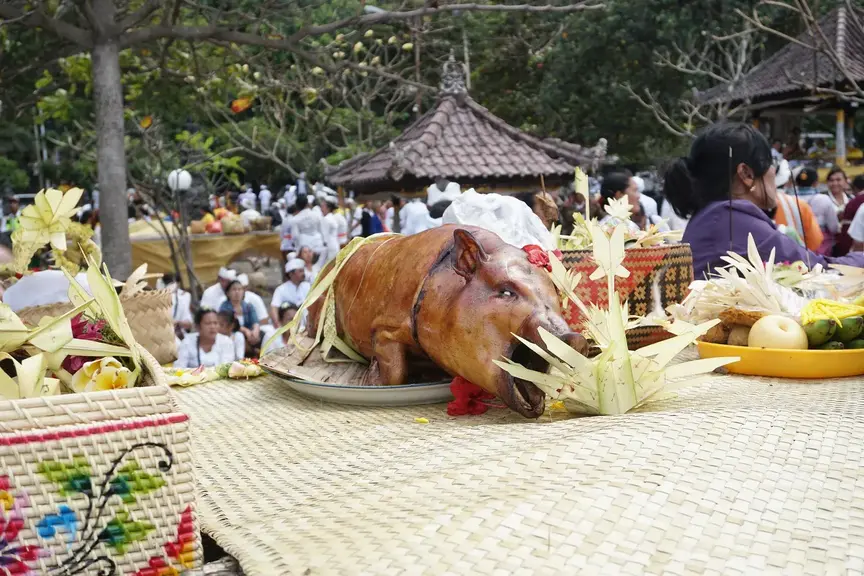
A whole babi guling dressed with palm-leaf offerings before a temple ceremony. The dish is ceremonial first, lunch second. Photo: I Kadek Jaya Wiguna, CC BY-SA 4.0, via Wikimedia Commons; resized and converted to WebP.
3. Sate lilit (minced satay)
Sate lilit starts with minced pork, chicken or fish, not chunks of meat. The cook mixes it with grated coconut, lime juice and spice, wraps it around a stick and grills it over charcoal. The coconut keeps it soft. The charcoal gives it the smoke.
Order it as part of nasi campur or by the stick. It travels well to a beach picnic.
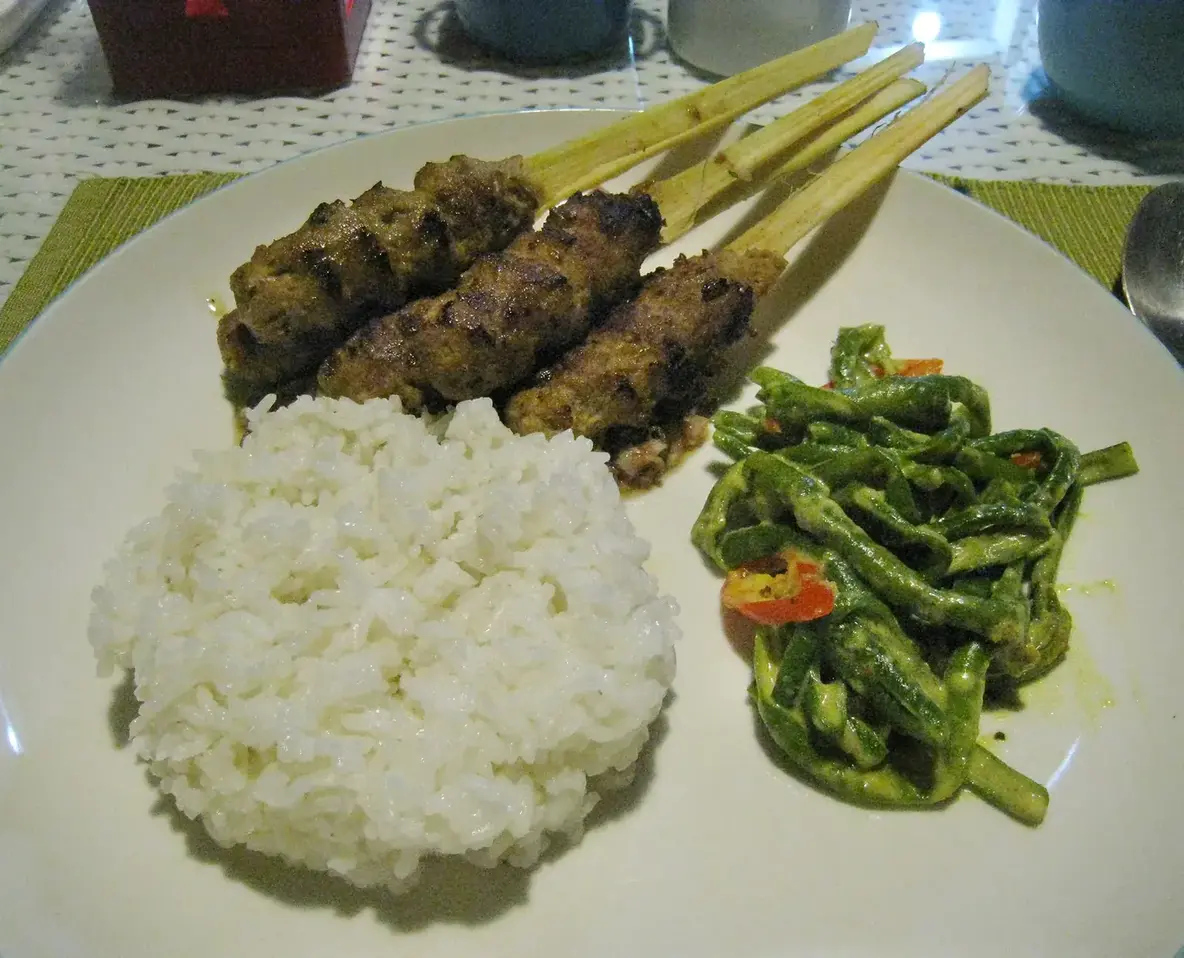
Sate lilit with rice and spiced long beans. Photo: Gunawan Kartapranata, CC BY-SA 4.0, via Wikimedia Commons; resized and converted to WebP.
4. Bebek betutu (the patience dish)
The cook rubs a duck with spice, wraps it in banana leaves and husks, then cooks it for 8 to 12 hours. The meat falls off the bone into a pool of spiced broth. It is the most expensive thing on most warung menus, and worth ordering once.
Ask for it a day ahead at smaller warungs. The good ones cook to order, not to hold.
5. Lawar (the dish that is not automatically vegetarian)
Lawar is chopped long beans, grated coconut and spice. Blood gives the red version its color. The white version is milder. Both often contain minced pork or chicken, so "white" does not mean meatless.
If you do not eat meat, say "lawar tanpa daging" and confirm there is no terasi. The vegetarian version exists. It is not the default.
What a Balinese meal costs in 2027
Item | Price (IDR) | Basis |
|---|---|---|
Babi guling, local warung | 12,000-48,000 | Eight warungs surveyed by Grab, Oct 2025 |
Inexpensive restaurant meal, Bali average | 50,000 | Numbeo, Nov 2026 |
Meal for two, mid-range | 509,000 | Numbeo, Nov 2026 |
Cappuccino | 40,000 | Numbeo, Nov 2026 |
Domestic beer, 0.5 liter | 40,000 | Numbeo, Nov 2026 |
Numbeo figures are November 2026 Bali averages. The babi guling range comes from Grab's survey of eight warungs. Most warungs take cash or QRIS; some venues add a card surcharge.
A warung inland charges closer to IDR 20,000 for a plate than one beside a beach club.
Fine dining and the chefs behind it
The island also has a fine-dining scene that deserves one dinner. Locavore NXT in Ubud ranked 44th on Asia's 50 Best Restaurants 2026. It won the Sustainable Restaurant Award in 2025. The kitchen runs up to 20 courses from a rooftop food forest, a fermentation lab and an underground mushroom chamber, and the menu is plant-forward (Asia's 50 Best).
You can eat a 20-course Indonesian tasting menu built on foraged cassava, banana blossom and zero-waste dashi. The next day you eat nasi campur for lunch for a fraction of the price.
Bali trains its own chefs. Ardika Dwitama, pastry chef at August in Jakarta, won Asia's Best Pastry Chef 2026. He was part of the opening team at Will Goldfarb's Room 4 Dessert in Ubud in 2014. He builds desserts on palm sugar, honey and coconut sugar instead of imported refined sugar (Asia's 50 Best).
Vegetarian and plant-based: what to ask
Traditional Balinese cooking has plenty of options, but vegetarian and vegan are not the same thing here. Several dishes use terasi (fermented shrimp paste) in the spice base or sambal, and gado-gado traditionally includes hard-boiled egg.
Gado-gado (vegetarian, vegan if modified): blanched vegetables, bean sprouts, hard-boiled egg and crispy tempeh with warm peanut sauce. Ask for no egg and confirm the sauce has no terasi.
Tipat cantok (vegetarian, confirm terasi for vegan): pressed rice cakes and fresh greens in a mortar-ground peanut paste. The paste often includes terasi.
Lawar putih (not reliably vegan): the white version skips the blood, not necessarily the meat. Ask for lawar tanpa daging and no terasi.
Nasi goreng (vegan if modified): ask for no egg, no shrimp paste and no kecap with fish extract. Most kitchens will do it.
The safest bets are dedicated vegetarian warungs in Ubud and Canggu, where the staff do not have to rewrite a family recipe to feed you.
What to drink with it
Arak is the island's spirit, distilled from coconut or palm sap and usually 20 to 40 percent alcohol. Indonesia recognized it as intangible cultural heritage in 2022, and 29 January is Arak Bali Day. Tuak is the same sap before distillation, fermented to about 4 to 10 percent and drunk with meals.
Buy sealed, labeled bottles and drink in bars and restaurants that have a license. Some unregulated arak contains methanol. Methanol can cause blindness and death. The cheap cocktail is the usual delivery method. Bali Governor Regulation No. 1 of 2020 tightened production and labeling, but enforcement is uneven (Bali Holiday Secrets).
Kopi is the safer habit. Bali's arabica comes from the highlands around Kintamani, and most warungs serve it as kopi tubruk: grounds in the cup, hot water on top, sugar on the side. Let it settle before you drink.
Jamu is the herbal tonic tradition UNESCO inscribed in 2023 (UNESCO). Look for beras kencur (rice and aromatic ginger) and kunyit asam (turmeric and tamarind) in warungs and small shops. It is bitter, bright and cheaper than a smoothie.
How to eat well without the tourist markup
Follow the drivers at lunch. A warung packed with Balinese workers at 12:30 is fresh, fast and cheap. An empty one with a photo menu is neither.
Eat babi guling before 1pm. The crackling does not survive the afternoon, and the best pots are sold by two.
Carry cash. At most warungs, you pay bills under IDR 150,000 in cash or by QRIS. Cards are for restaurants, not kitchens.
Learn five phrases. "Tidak pedas" (not spicy), "sambal terpisah" (sambal on the side), "tanpa daging" (no meat), "tanpa terasi" (no shrimp paste), "bungkus" (takeaway).
Skip the smoothie bowl. It costs more than a plate of nasi campur and tells you nothing about the island.
Night markets and what to eat there
Sindu Night Market in Sanur and Gianyar Night Market come alive at sunset with charcoal grills, pisang goreng and nasi jinggo wrapped in banana leaves. Arrive by 6:30, carry small notes, and buy from the stall with the longest local queue.
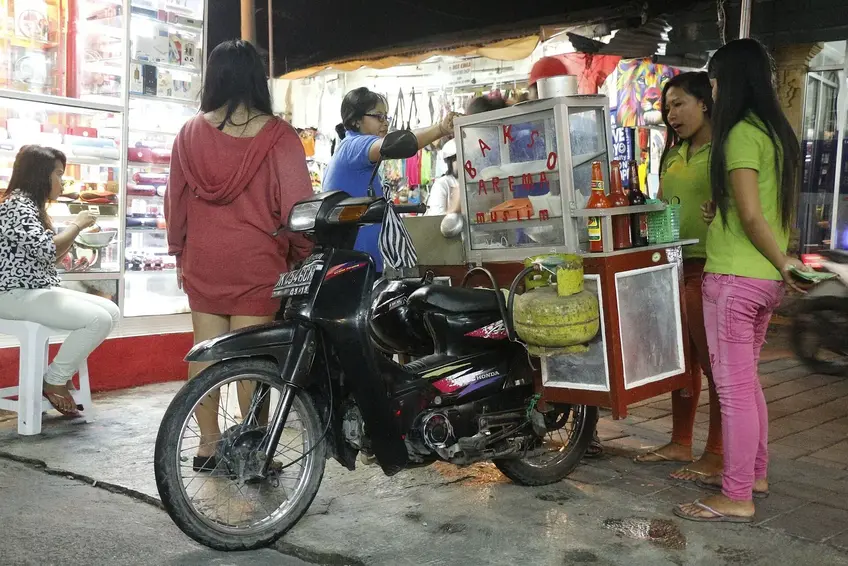
A street food cart in Kuta at night, the same setup you will find at the night markets. Photo: Robert Nagel, CC BY-SA 4.0, via Wikimedia Commons; resized and converted to WebP.
Ubud market is worth a lap before lunch, even if you are only buying fruit.
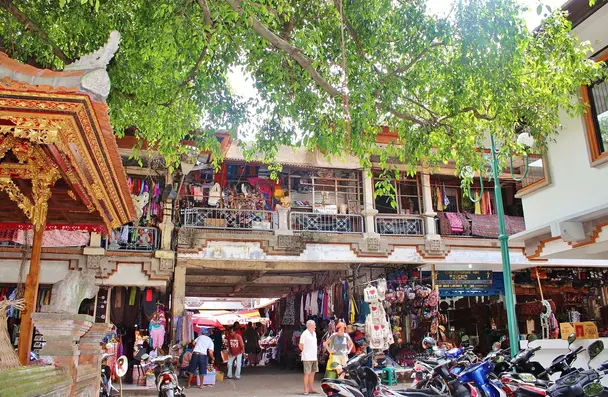
Ubud market, a five-minute walk from the palace and the warungs around it. Photo: Michelle Maria, CC BY 3.0, via Wikimedia Commons; resized and converted to WebP.
Many of the best warungs sit in the villages and back lanes of Gianyar, Sanur and the Ubud highlands. A private car with a local driver through BaliRoam makes them easier to reach without chasing tourist traps. A private car charter also removes the parking problem and the guesswork about which lane holds the good warung.
Frequently Asked Questions
What is the most popular dish in Bali?
Nasi Campur and Babi Guling are the two most iconic. Nasi Campur is rice with small portions of whatever the warung cooked that day — a different meal every time. Babi Guling is spit-roasted suckling pig with glass-crisp skin, stuffed with a spice paste called Base Gede.
Is Balinese food very spicy?
It can be, especially Sambal Matah (raw shallots, lemongrass, and bird's eye chilies). If spice is not your thing, just say "Tidak pedas" or ask for sambal on the side. Many dishes like Nasi Campur and Gado-Gado are mild by default.
What is a warung?
A warung is a family-run eatery where most real Balinese cooking happens. They serve simple, fresh dishes at low prices. If a warung is packed with local drivers and workers at lunch, it means the food is good and the turnover is high.
Is there good vegetarian food in Bali?
Yes. Traditional Balinese cooking uses tempeh (fermented soybean cakes) and tofu in everyday dishes. Gado-Gado (blanched vegetables with peanut sauce), Tipat Cantok (rice cakes with fresh greens), and Lawar Putih (chopped jackfruit and coconut) are all naturally vegetarian.